National Broadcaster Removes TV Series Húsó at Producer Glassriver’s Request While Statutory Author Credits Remain Uncorrected

Updated: Feb 17
Update (February 7, 2026): Húsó has now been reinstated on RÚV’s platforms (available in Iceland), where I am credited as created by, story by, and executive producer on all episodes, and written by on episode one. No court ruling has been issued, and no settlement agreement has been concluded
After almost three years of asserting my statutory authors’ rights, this represents an important factual change. The current credits still do not fully or accurately reflect my authorship, and I am reviewing next steps with my legal counsel.
This article documents the factual timeline, public funding context, and unresolved statutory obligations regarding author attribution in the television series Húsó.
On January 24, 2026, all major media outlets in Iceland reported that RÚV, the national public broadcaster, removed the television series Húsó from its platform. The removal was made at the request of the producer, Glassriver. No explanation was published to viewers, despite the series previously being advertised as available until 14 November 2026.

Screenshot taken in November 2025
Recent media coverage:
DV: https://www.dv.is/frettir/2026/01/28/ruv-hafi-ekki-att-frumkvaedi-ad-thvi-ad-taka-huso-ur-birtingu-visi-fra-ser-abyrgd-thratt-fyrir-eignarhlut-og-95-milljona-framlag Mannlíf: https://mannlif.is/greinar/dora-leidrettir-misskilning-fjolmidla/ DV: https://www.dv.is/frettir/2026/1/24/segir-ruv-hafa-tekid-islenska-sjonvarpsthattarod-ur-birtingu-og-muni-ekki-birta-hana-aftur-fyrr-en-ad-uppfylltum-skilyrdum/
Mbl (Morgunblaðið): https://www.mbl.is/frettir/innlent/2026/01/24/ruv_tekur_vinsaela_thaetti_ur_birtingu/ Vísir: https://www.visir.is/g/20262833595d/huso-fjar-laegdir-af-ruv-eftir-a-greining-um-kreditlista
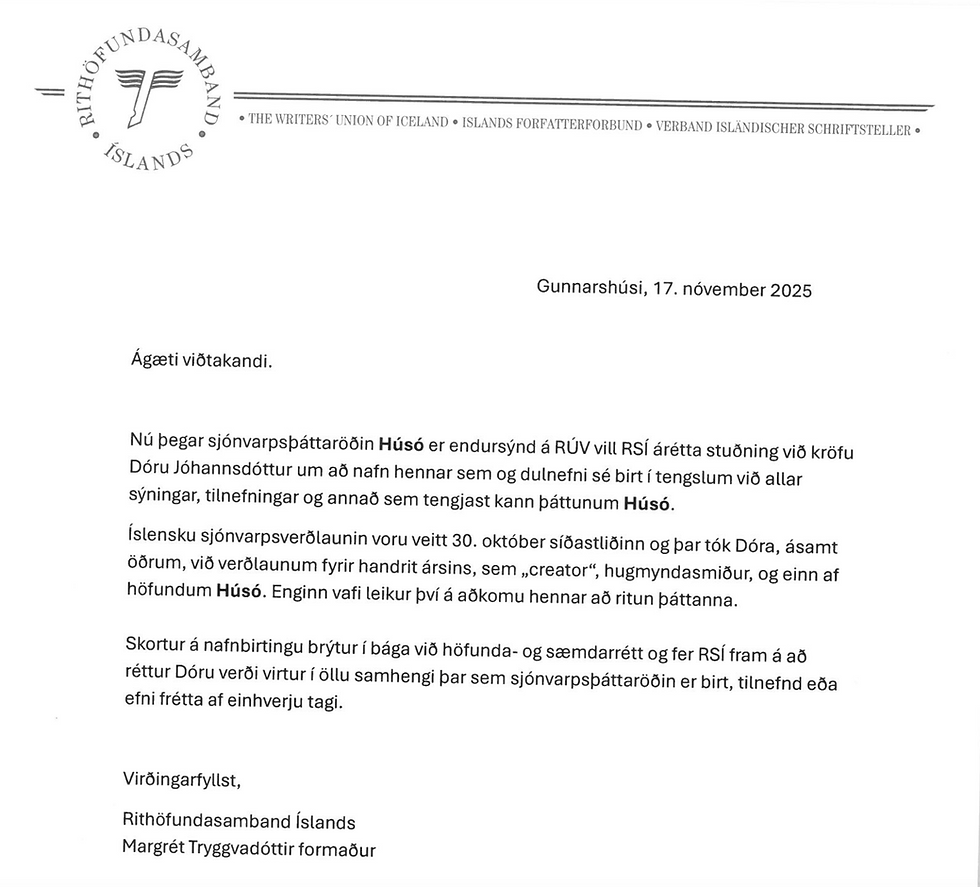
In December 2025, the Icelandic Federation of Artists (BÍL) formally expressed its support for my demand that my name and pseudonym be credited in all contexts related to Húsó.
The Icelandic Federation of Artists stated explicitly that there is no dispute regarding my authorship and emphasized that author credit is a statutory and inalienable part of moral rights, which cannot be waived, negotiated away, or ignored through inaction.
Neither RÚV nor the producer responded to this request.
BÍL also noted that I had already received the Icelandic Television Award for Best Screenplay as one of the authors of the series, underscoring that my contribution is publicly acknowledged yet still not reflected in the official credits.
I have been invited to participate in a panel at Berlinale in February as a female creator of a television series, and in that context I have been asked to provide a copy of the series. I am currently unable to do so, as I do not have access to my own work. This causes direct professional harm.
RÚV has stated that the series will be made available again once the producer delivers an updated and correct credit list. However, Húsó was both premiered and rebroadcast by RÚV without me receiving the statutory author credit to which I am entitled.
Despite repeated requests, the producer has delivered neither to the author nor to RÚV copies of the series with corrected credits. No consequences have followed this delay for the producer, despite the fact that it causes the author ongoing and demonstrable harm. Correcting author credits is a routine administrative action in comparable productions and does not require renegotiation of rights or agreements.
This has never been a question of disagreement between authors. It is a question of respecting moral rights.
As stated by BÍL, author credit is a statutory and inalienable part of moral rights and cannot be limited by contract or negligence.
Failing to credit an author for their copyrighted work is unlawful. Making an author’s name attribution conditional is impermissible. Yet this unlawful situation has persisted for more than two years.
In November, the Icelandic Writers’ Union (RSÍ) sent a formal request to RÚV and Glassriver which was not answered. RSÍ sent a follow-up in January, emphasizing that my demand for name attribution in connection with Húsó must be fulfilled without further delay.
Húsó was largely financed by RÚV and also received public funding through reimbursement from the Ministry of Culture, Innovation and Higher Education, as well as a screenwriting grant from the Icelandic Film Centre.
Despite strong professional backing, my application for legal aid to pursue the case in court was rejected on the grounds that the case “concerned my profession.” In practice, this means that no working artist or self-employed creator in Iceland can receive legal aid in cases involving violations of copyright or moral rights.
Damages awarded in copyright cases in Iceland have historically been very low. Precedents show that even a legal victory would likely result in a financial loss for the author.
I have received no answer to the question of who bears responsibility for ensuring that statutory authors’ rights are respected in a publicly funded project on a public-service broadcaster.
Is it reasonable that authors must personally bear the full financial, psychological, and professional cost when companies and public institutions handling public funds fail to comply with the law, and no effective remedies exist to enforce respect for statutory authors’ rights?
(For further context, see other articles on djok.is/en/greinar including: Justice Has a Price.)


Comments